

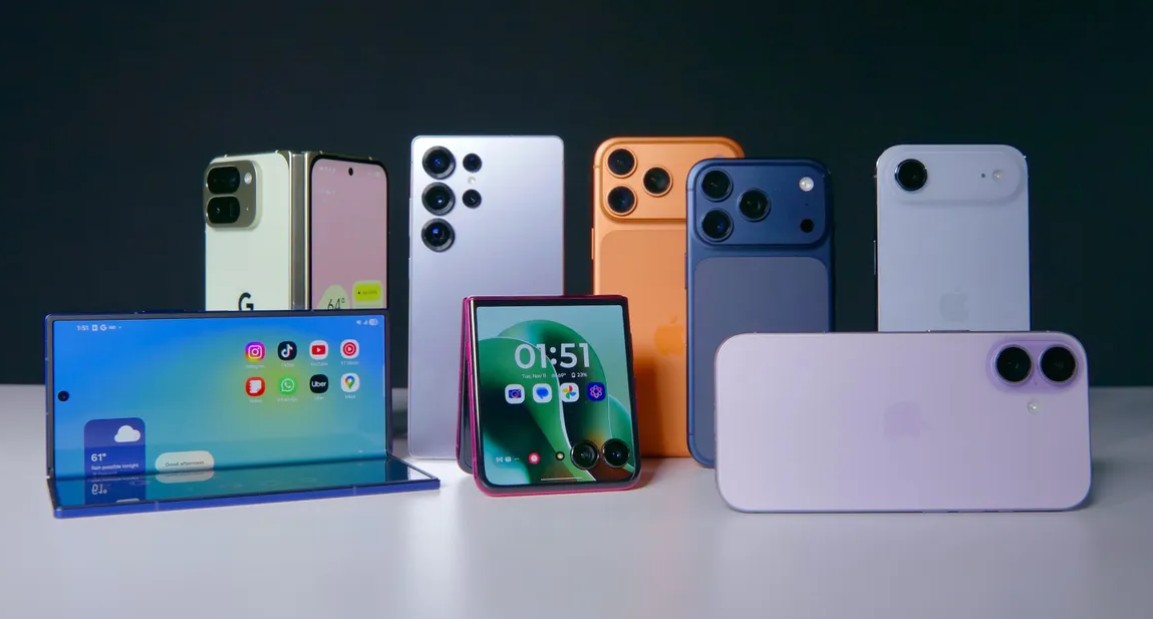
The physical design of smartphones reached a turning point this year.
-
iPhone 17 “Air/Slim”: Apple has shifted focus toward extreme thinness. The 2026 iPhone lineup features a new “Slim” model that replaces the Plus, focusing on a titanium-aluminum alloy frame that is incredibly light yet durable. Apple has also finally removed the charging port entirely on some Pro models, moving fully to MagSafe 3.0 high-speed wireless data and charging.
-
Android’s Foldable Maturity: While Apple still hesitates on a foldable, the Samsung Galaxy Z Fold 8 and Pixel Fold 3 have perfected the form factor. These devices are now as thin as standard iPhones when folded, making them the preferred choice for power users who want a tablet-sized screen in their pocket. You can check the detailed hardware rankings on DxOMark to see how these designs impact camera optics and sensor size.
Ecosystem and Interoperability: The Walls are Crumbling
Due to global regulations like Europe’s Digital Markets Act (DMA), the “Walled Garden” of Apple is not as locked as it used to be.
-
Messaging: RCS (Rich Communication Services) is now fully standard on iPhones, making “Green Bubbles vs. Blue Bubbles” a thing of the past. High-res photos and read receipts work perfectly between platforms.
-
App Stores: On Android, sideloading and third-party stores have been standard for years. In 2026, iPhone users in many regions can now also install alternative app stores, giving them more freedom but also requiring more attention to security.
-
Cross-Device Flow: Apple still wins here. The way an iPhone interacts with an Apple Watch and a Vision Pro headset remains more fluid than the fragmented (though improving) Android-Windows-WearOS ecosystem.
Sustainability and Longevity: The 7-Year Standard
In 2026, sustainability is a major selling point. Both camps have made massive strides:
-
Software Support: Both Google and Samsung now match Apple by offering 7 to 8 years of OS updates. This has significantly increased the resale value of Android phones, which used to depreciate much faster than iPhones.
-
Repairability: Following the lead of brands like Fairphone, the latest smartphone reviews highlight that Android manufacturers are making batteries and screens easier to replace. Apple has also expanded its “Self Service Repair” program, though they still use software locks (part pairing) more aggressively than Android brands.
Direct Comparison: iPhone 17 Pro vs. Samsung Galaxy S26 Ultra
| Feature | iPhone 17 Pro | Galaxy S26 Ultra |
| Main Chip | A19 Pro (3nm) | Snapdragon 8 Gen 5 |
| AI Capabilities | On-device “Siri 2.0” | Cloud-hybrid Gemini |
| Camera | 48MP Triple-Lens (New Zoom) | 200MP Quad-Lens (100x Space Zoom) |
| Charging | MagSafe 3.0 (No Port?) | 65W USB-C Wired |
| Biometrics | FaceID (Under-display) | Ultrasonic Fingerprint + Face |
| Price | Starts at $1,099 | Starts at $1,199 |
Frequently Asked Questions (FAQs)
Q1: Which has a better camera in 2026, iPhone or Android?
It is a draw. iPhone is still the king of Video—its cinematic modes and ProRes logs are unbeatable for creators. Android (specifically Samsung and Xiaomi) wins in Zoom and Macro photography.
Q2: Is the iPhone 17 still using a notch or Dynamic Island?
By 2026, the Pro models have moved FaceID sensors under the display. You only see a small “hole-punch” for the camera, which disappears when watching full-screen video.
Q3: Which phone is better for Crypto and AI developers?
Android is generally preferred by developers due to its open-source nature and the ability to run custom AI kernels. However, Apple’s CoreML is extremely efficient for developers targeting the iOS user base.
Q4: Are iPhones more secure than Androids in 2026?
The gap is almost closed. While Apple’s “Sandboxing” is stricter, Android’s “Play Protect” and hardware-level encryption (Knox) provide enterprise-grade security. The biggest risk on both is still user-targeted phishing.
Q5: Do Android phones still lag after a few years?
No. With UFS 5.0 storage and improved RAM management in Android 16/17, the “lagging after two years” issue has been solved for flagship and high-end mid-range devices.
Final Verdict: Which Should You Buy?
Choose iPhone 17 if: You want the most stable, polished experience, the best video camera in the world, and you are already invested in the Apple Watch or Mac ecosystem.
Choose Android if: You want cutting-edge hardware (like foldables), superior AI integration with Google services, or a device that you can truly customize and control without restrictions.
In 2026, there is no wrong choice—only the choice that fits your digital lifestyle.

