

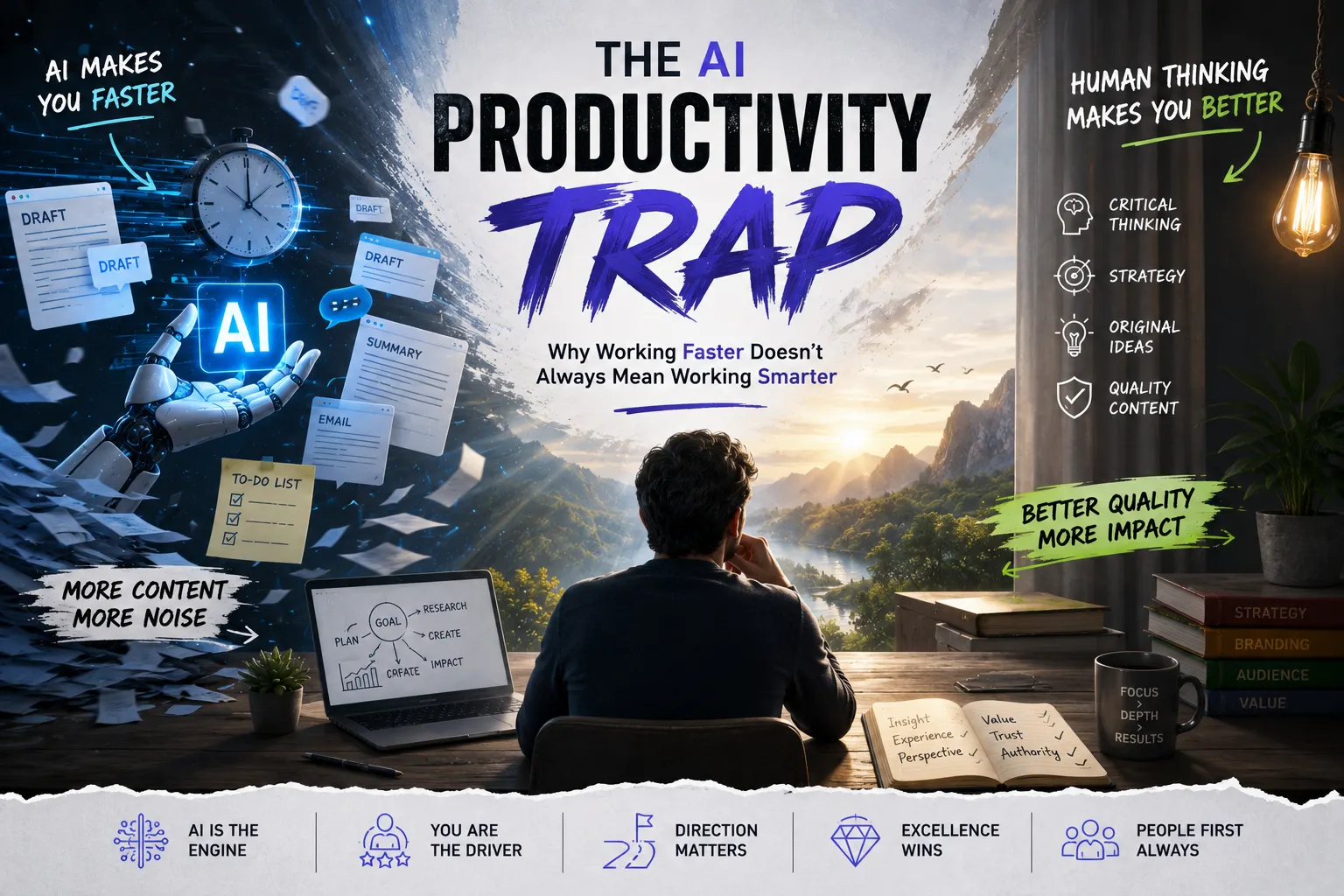
Everyone Is Chasing Speed
Not long ago, creating a blog post required hours of brainstorming, researching, writing, and editing.
Today, AI can generate an outline in seconds, draft an article in minutes, and even suggest headlines before you’ve finished your coffee.
It sounds like the perfect productivity revolution.
But there’s one problem.
Speed alone doesn’t create value.
In a world where almost everyone has access to the same AI tools, the real competitive advantage is no longer how quickly you can create content — it’s how well you think.
The Rise of AI Productivity
There’s no denying that AI has made everyday work easier.
Professionals across every industry now use AI to save time on repetitive tasks.
Some of the most common uses include:
- Writing first drafts
- Brainstorming new ideas
- Summarizing lengthy reports
- Organizing research
- Improving grammar and readability
- Creating social media captions
- Planning marketing campaigns
Instead of replacing creativity, AI removes many of the repetitive tasks that slow us down.
This allows professionals to spend more time making strategic decisions rather than performing routine work.
That’s where AI delivers its greatest value.
When Productivity Becomes a Trap
Being productive feels satisfying.
Finishing ten tasks in a day sounds impressive.
Publishing five articles every week seems like success.
But productivity becomes dangerous when speed replaces thinking.
Many people now:
- Publish AI-generated content without editing.
- Skip fact-checking.
- Ignore originality.
- Prioritize quantity over quality.
- Believe faster always means better.
Unfortunately, readers notice.
So do search engines.
Creating more content doesn’t automatically create more authority.
Sometimes, it simply creates more noise.
Press enter or click to view image in full size

What Google’s Recent Direction Is Really Telling Us
One of the biggest misconceptions is that Google rewards content simply because it’s created with AI.
That’s not how modern search works.
Google’s focus has increasingly been on rewarding content that is:
- Helpful
- Accurate
- Original
- Trustworthy
- Created with genuine expertise
- Useful for real people
Whether a piece of content is written with AI assistance or entirely by a human matters less than whether it genuinely helps readers.
This is why businesses should stop asking:
“Can AI write this?”
Instead, they should ask:
“Will this genuinely help someone?”
That simple shift changes everything.
The Productivity Balance
The most successful professionals don’t reject AI.
They don’t depend on it either.
Instead, they create a balanced workflow.
Step 1
Use AI for research and brainstorming.
Step 2
Write your first draft faster.
Step 3
Add personal insights.
Step 4
Verify facts.
Step 5
Improve readability.
Step 6
Publish only when the content truly provides value.
This workflow combines the speed of AI with the judgment of human expertise.
Expert Insight
The future won’t belong to people who simply use AI.
It will belong to people who know when to use AI — and when not to.
As AI becomes available to everyone, creativity, experience, critical thinking, and original ideas become even more valuable.
Technology may level the playing field.
Human judgment is what creates real differentiation.
A Quick Self-Assessment
Before publishing your next piece of content, ask yourself:
✅ Did I verify the facts?
✅ Did I add my own perspective?
✅ Does this solve a real problem?
✅ Would I personally trust this information?
✅ Is this better than what’s already available?
If the answer is “yes” to all five questions, you’re already ahead of many creators who rely entirely on automation.
Key Takeaways
- AI is an incredible productivity tool — but it’s not a replacement for expertise.
- Faster content creation doesn’t always lead to better results.
- Google’s direction continues to prioritize helpful, people-first content.
- Human creativity, strategy, and critical thinking remain essential.
- The best professionals use AI as an assistant, not as the final author.
Final Thoughts
Artificial intelligence has fundamentally changed how we work, and there’s no turning back.
But in a world where everyone has access to the same tools, speed is no longer the biggest advantage.
The real advantage comes from combining AI with experience, thoughtful decision-making, and genuine expertise.
The future isn’t about humans competing with AI.
It’s about humans learning how to work alongside AI more intelligently than everyone else.
Thanks for reading.
If you enjoy practical insights on AI, SEO, and digital marketing, feel free to follow for more articles.

