

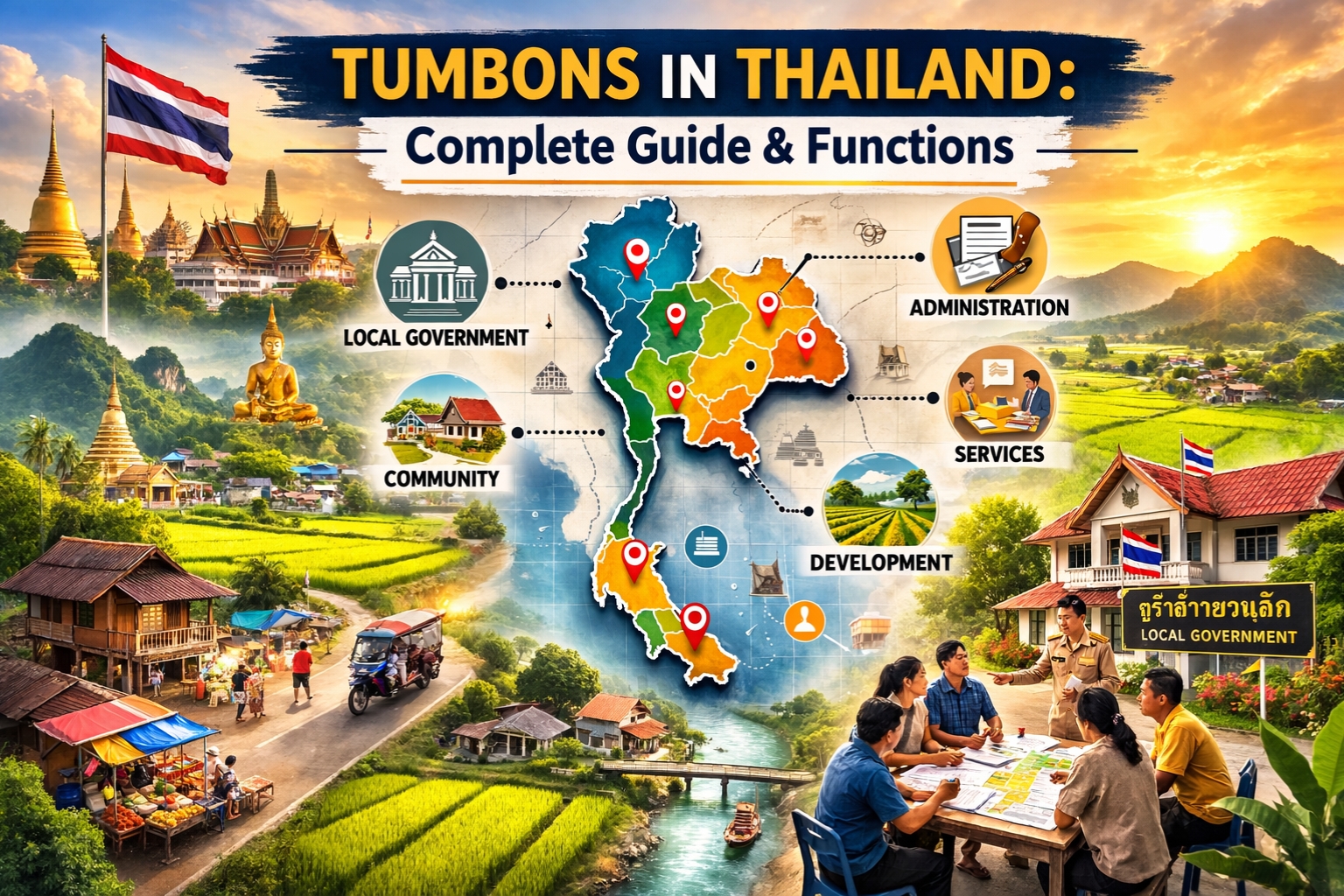
Tumbons! Thailand’s rich culture and complex administrative systems have led to a unique division and sub-division of regions to ensure efficient local governance. One of these sub-divisions is called a tumbon (ตำบล), which has great importance in local governance, community organization, and the delivery of public services.
What Is a Tumbon?
A tumbon is a unit of administration below the level of a district (in Thai, this is called an amphoe). Therefore, a tumbon are localized governance subunits that offer administrative control and operational oversight over a number of communities. Within a tumbon, there are multiple villages, referred to in Thai as muban (หมู่บ้าน). These villages are the smallest administrative units within Thailand and are the epicenter of everyday life, where people interact with one another and where local governance is practiced.
Structure of Tumbons
Each tumbon has a subdistrict headman referred to as a phu yai ban. The phu yai ban coordinates with district officials and oversees village heads. While each subdistrict headman handles the administrative work on the subdistrict level, each village within the tumbon has a village chief who directly engages on the daily management of the village and reports to the subdistrict authority.
The structure of a tumbon generally has:
- Several Villages (Muban) – Depending on the population and geographical area, each tumbon can have as few as three villages and as many as twenty or more.
- Administrative Office – This is the center of local administration, where paperwork, civil registration, community development projects, and local policing are organized.
- Local Councils – Many tumbons have elected councils that contribute to the community’s decision making, especially with development projects, budget allocations, and provision of public services.
- This multi-layered structure: enables the district to centrally control policy implementation and allows more locally-based control over the management of community issues.
Functions and Responsibilities
1. Local Governance
Tumbons serve as the middle men of the district and the village. They are responsible for the implementation of policies, directives and programs from the amphoes and the province, which for instance, include the construction of the roads and other health services.
2. Civil Registration and Documentation
Another key role of tumboons is to complete, and make sure the documents of the residents remain current. These documents include, but are not limited to the registrations of births, deaths, marriages and residential, etc. These documents are essential and primarily needed by residents in order to access administrative services from the government, including healthcare and education.
3. Community Development
Tumbons participate in the development of the community by engaging in the construction and development of local community projects such as; roads, schools, community buildings and water management projects. This gives tumboons the leeway to enhance the living standards of the residents and enables sustainable development to take root in the society.
4. Public Services
The provision of essential services is a primary function of tumbons. These include waste management, local market management, public safety management, and health management. By overseeing these services, the tumbon ensures that the villagers have the essential services that they require for their day to day life.
5. Cultural Preservation
Many tumbons also help in the preservation of customs, traditions, festivals, and cultural heritage. They help in the organizing of festivals, supporting the local craftspeople, and the management of places of worship and heritage sites, which in turn helps to develop the community and promote social integrity.
Significance of Tumbons in Thailand
The tumbon system is as significant in Thailand’s governance as it is in the management of the rural and urban community systems. The governance system divides the districts in order to deal with all of varied phenomena in Thailand’s population. Tumbons offer:
- Local representation: Villagers have the opportunity to engage and represent their interests to the leadership directly.
- Efficient service delivery: Public service management is done closer to the community.
- Community participation: Citizens are able to make decisions that affect their community directly and their participation improves the relevance and effectiveness of policies.
FAQs
Q1. What is the difference between a tumbon and an amphoe?
A: A tumbon is made up of several villages and is, therefore, a subdivision of a district (amphoe). The amphoe is, therefore, the higher administrative tier and is concerned with broader governance.
Q2. Typically how many villages are included in a tumbon?
A: Depending on the geographical area and population size, a tumbon includes 3 to 20 or more villages (muban).
Q3. Who is in charge of the tumbon?
A: The leader of a tumbon is called the phu yai ban, or subdistrict headman, who works with district administration and village chiefs to handle local administration and service delivery.
Q4. What are the services that tumbons offer to the people?
A: Tumbons are responsible for organizing civil registries, developing local services, organizing waste collection, ensuring public order, promoting community safety, and providing other relevant services.
Q5. What is the significance of tumbons in Thailand?
A: Tumbons are important in Thailand because they promote effective local administration, representation, and participation, as well as maintain district administration and cultural identity at the local level.
Conclusion
In the case of tumbons, the foundational feature of Thailand’s administrative system is described. Each tumbon is made of several villages and acts as a link between the district management and the local population. They are engaged in a wide range of activities from governance and civil registration to community development, and the management of culture. Knowing what tumbons do is to know how Thailand strategically deals with its huge social and administrative complexities while still maintaining a significant local connection.
Tumbons have contributed to stability, development and social cohesion in the country as a result of their skilful community organization and the facilitation of local governance.
Those interested in culture, social interaction and administration in Thailand will find it insightful to study the tumbon system, as it illustrates well how local governance functions in a complex society.

