

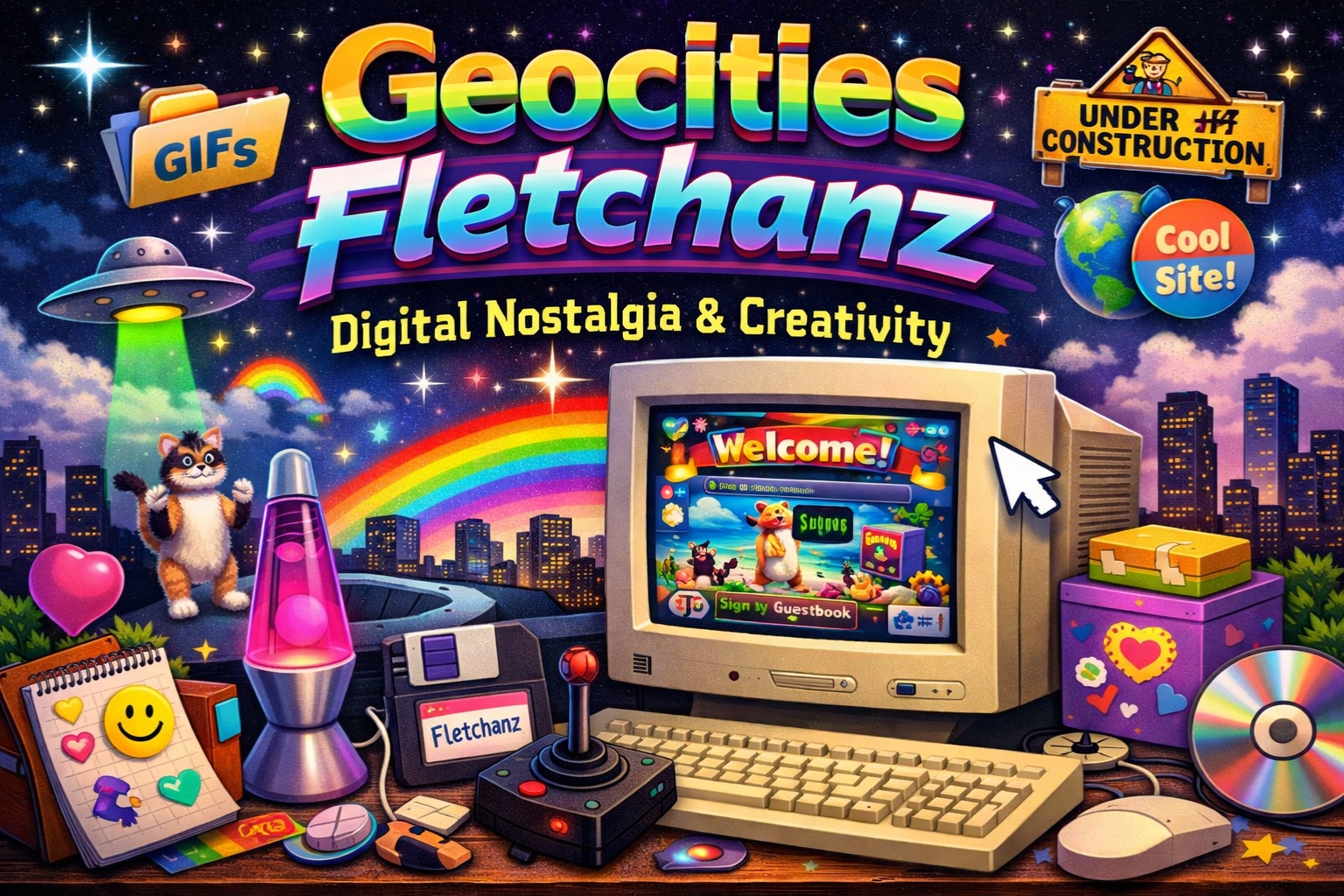
Geocities Fletchanz! The early days of websites that had personality rather than advertisements, and that lacked slick algorithms to curate and data mine your activity, embeds of social media, and buzzwords like “user experience”, feel like a million years ago to a lot of us. Fledgling internet entrepreneurs developed their creativity around web design, multimedia, and personal expression. One of the websites that was born in this internet Wild West is GeoCities, where a new phenomenon called Geocities Fletchanz is a combination of nostalgia, creativity, and the promotion of free web culture.
So how does one define Geocities Fletchanz? Primarily a creative expression, theme, or variation of subculture relating to the GeoCities era. A melding of the aesthetics, design, and personal expression of that time when the internet was unspoiled and free. In the following, I aim to express the essence of Geocities Fletchanz and its importance, and how this combination of digital nostalgia and creativity can be claimed by anyone.
The Loss of Digital Identity Within Today’s Web Culture
The rapid expansion of the World Wide Web has resulted in the evolution of many modern websites with design features that focus more on user experiences (such as the ease of navigation on the site). Websites now also use design features that promote (greater) monetization. But, the possibilities of individual creativity have been diminished. The use of (animated gifs) and custom site backgrounds, as well as (certain) site layouts has resulted in the removal of personal site designs that provided the user with space to display that creativity. Now, many users are left with what has been described as a (social media) ‘digital monoculture’.
The loss of individual and creative site design has resulted in the loss of the social (digital) playgrounds that provided users with the ability to design creative online spaces, like (the now defunct) GeoCities. The importance of the Geocities Fletchanz project is that it is more than an exercise in (crowd sourced) digital design. It is a modern example of dealing with the problem of online ‘creative stagnation’. GeoCities Fletchanz is (encouraging and) invoking the need to use the ‘design space’ provided by the Geocities Fletchanz project to (within the project) display your non-linear, playful, and self expressive digital designs.
The solution: Geocities Fletchanz
To reconnect with Geocities Fletchanz, one must delve into its history and apply it to the present digital framework. Here is a three-step approach:
Step 1: Comprehend the GeoCities Period
GeoCities launched in 1994 and offered users the ability to create personal web pages, which were sorted into “neighborhoods” according to their interests. The web pages were visually busy, personalized, and contained:
- Bright and patterned backgrounds
- Animated gifs and midi audio
- HTML customizations
- Guestbooks and visitor counters
Driven by a love of geography and the internet, Fletchanz channels this period of the internet and all its creative chaos, celebrating the different and the individual, and the imperfection of the internet.
Step 2: Identify Your Creativity
Branching out in various aspects of the internet, Geocities Fletchanz is more than just copying old digital aesthetics, it’s allowing you to express digital individuality. Ask yourself:
- What themes or aesthetics do you identify with? (retro, cyberpunk, whimsical, etc.)
- What signature graphics or styles do you favor? (e.g. pixel art, animated icons)
- What kind of voice do you want to maintain across your digital identity?
All of these will create a unique identity that resonates with the spirit of GeoCities and makes your space one of a kind.
Step 3: Design and Content Experimentation
At the core of Fletcher is the possibility of experimentation. Unlike traditional websites that prioritize ease of use and the same sterile layout for each page, Fletcher encourages the use of:
- Graphics that: Include layers and off-the-beaten-path design choices
- Interactivity: Polls, games, guest books, etc.
- Combined media: Music, videos and animations
All of the above enable you to turn the digital space into what echoes the early web experimentation – a personal canvas.
Step 4: Building the Old Look With the New Tools
You won’t have to rely on antiquated services. Many services available today allow for the same retro web experience:
- Neocities: A modern take on GeoCities
- Editors for html and css: A basic understanding of coding enables you to take control of your layout and design choices
- Digital archives: Actual GeoCities pages accessed through the Wayback Machine offer design inspiration.
Using modern resources to create a fusion of nostalgia with the retro look will make your designs both practical and evocative of the original era.
Step 5: Disseminate and Network with Similar Interests
Fletchanz is more than just personal expression; it is about community. When you post your work on forums and retro web communities or social media groups you can:
- Exchange ideas and get inspired
- Get feedback
- Help revive the early web aesthetics
Reddit’s retro web communities and Neocities are great examples of Geocities-inspired creativity and are great places to keep the subculture alive.
Tips and Examples: Bringing Fletchanz to Life
Here are great ideas to get you started with Geocities Fletchanz:
- The Retro Look is the Goal: Make your first page chaotic. Make your second page chaotic. Web design is not about amazing and appealing. Web design is just doing.
- Do not get Lost: Make hidden links, animations, and anything else you can to keep users from getting bored.
- Use Retro Fonts and Graphics: Use pixel fonts, old images, and GIFs to please the audience and keep them.
- Keep track of it: Blog, keep a journal or document in any way your experiments. It is a great way to keep track of your digital identity.
- The Wayback Machine: GeoCities, and similar sites can help with site concept creation and analysis of what and how sites did what and how they did things in a way that made people take notice.
Example: A user might create a charming site honoring a made-up world, complete with animated avatars, a looping soundtrack, and a guest book to have people sign it like in the old days of the 90s.
Frequently Asked Questions (FAQs)
Q1: What Is Geocities Fletchanz?
A1: GeoCities Fletchanz is a reference to a specific kind of creative identity, theme, or subculture in the style of the GeoCities internet era exemplifying characteristics such as personal expression, retro web design, and playful experimentation in the way they capture the creativity of the internet’s first form of website creation.
Q2: What is the relevance of Geocities Fletchanz in today’s world?
A2: Today’s websites are generally more focused on sleek, minimal design, and the elimination of anything that is not directly related to the site’s monetization potential, or, with the goal of making things easy for the user by eliminating the potential for creativity and individuality in the user and the design of the site. GeoCities Fletchanz offers a way to break free from this by amplifying the playful creativity of the web’s early days.
Q3: What is the best way to go about on making a site in the style of Geocities Fletchanz?
A3: You can start by forming a creative identity, and use retro design ideas that may include, but are not limited to, animated GIFs, pixel-based type fonts, and random and unique combinations that form something like the old Geocities sites. Sites like Neocities offer basic editing of HTML and CSS to create the old web style design, which makes it easy to use your individual ideas from a vintage design perspective.
Q4: Is it possible to use GeoCities Fletchanz for social media or blogs?
A4: Yes! Even with social media’s limited customization, use retro and vintage design elements, whimsical social media branding, and playful use of content on posts, personal branding, or independent blogs to embody the spirit of GeoCities Fletchanz.
Q5: Where do I get ideas for Geocities Fletchanz designs?
A5: Wayback Machine holds old GeoCities pages, old web communities on Reddit, and Neocities projects. All of these places will help you get ideas from old designs and experiments.
Conclusion
As for Geocities Fletchanz is definitely a trendy thing, but it is also a way of thinking. It is possible to touch the early web spirit of experimentation using GeoCities. All current platforms restrict expression, so through GeoCities Fletchanz, you can make a profound and personal statement via the experimental web. Things like retro designs, distinctive digital personas, and silly multimedia arrangements excite the spirit of the 90s internet.
GeoCities Fletchanz helps to pay respect to the early days of the internet. It helps to show that in the early days, experimentation and individual expression were important. That’s what we need to now again, a internet with limitless expression and individuality. It is a way from the endless nostalgic and creative work to the present.

