

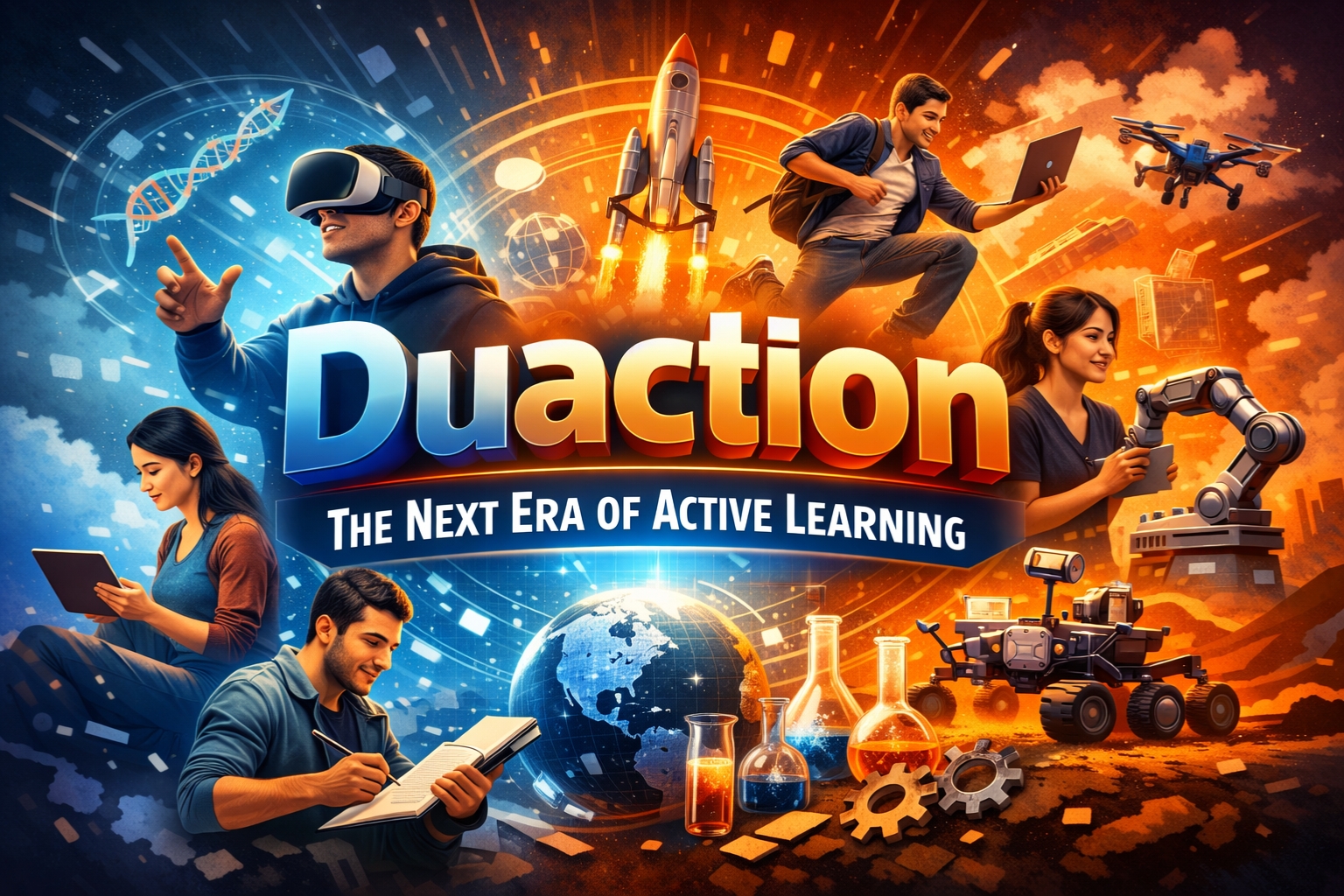
Duaction! Learners today demand faster ways to learn than traditional methods of rote learning, passive listening, and learning from books. Although these methods provide knowledge, they do not help build practical skills or learners’ confidence. Duaction is here to change the way we learn and embodies the hands-on practicality we need. It fuses learning with study and allows learners to build skills, tackle problems, and learn again in ways that are confident and practical in real life.
Duaction is an example of learning and practicing. It teaches learners to seize control of their learning. Instead of being passive, they must grapple with the ideas, experiment with them, and apply the concepts to real-world problems. This is exactly where the focus should be, in learning the skills that we need in every aspect of life, be it self-development or professional life.
Moreover, Duaction adopts a learning by doing philosophy. It appreciates that knowing a concept is not enough, and that to apply a concept is to achieve mastery of the concept. This is particularly important in disciplines where there is a need to be creative, possess relevant technical skills or be dynamically adaptable, such as software, engineering, entrepreneurship, and the arts.
The Shortcomings of Conventional Learning Approaches
It is alleged that modern learners have difficulty applying their knowledge. Although conventional education provides students with a grasp of theory, it often neglects the cultivation of skills or the fostering of analytical faculties. Common issues include:
- Learning by rote – Students often memorize facts, but lack understanding of their practical use. Students may have difficulty solving issues despite having the ability to recite textbook definitions.
- Deficient Confidence – Students, owing to the lack of practical experience, feel ill-equipped to confront challenges, whether in the academic or the professional world.
- Problem Solving Deficiencies – Learning by memorization results in an inability to think about problems in a creative, or systematic manner. Although a substantial number of students can reproduce answers to problems that can be found in a textbook, most cannot do so with respect to problems that other people have not solved.
- Skill Shortages – There is an increasing number of skills, such as coding, design thinking, financial literacy, and project management, that students do not learn in a conventional classroom and that employers or industry players are on the lookout for.
The above issues are a clear indication of the fact that learners lack the ability to handle real-life situations, problems, or tasks, whether in the professional world, in personal projects, or in creative pursuits. Education becomes a simple cycle of knowledge absorption rather than an enabling experience that builds ability and self-confidence.
Even the modern learner’s problem of short concentration spans and the abundance of distractions as a result of technology are additional reasons as to why traditional teaching by way of lectures is an even greater waste of time. Engaging the brain and results in reinforcing knowledge by the use of active techniques rather than Passive Learning can be more beneficial. Engaging the brain and results in reinforcing knowledge by the use of active techniques rather than Passive Learning can be more beneficial.
The Solution: What makes Duaction Different
Duaction overcomes these problems by embedding the principles of active learning into a defined, pragmatic instructional design process. This is how it works, step-by-step.
Step 1: Integrate Theory with Practice
Duaction encourages learners to apply what they study, from the beginning. For instance, the lesson on data analysis theory is complemented with a project where learners will work with actual datasets. This reinforces knowledge in practice and builds real-world skills.
Practice in context builds both competence and confidence. Engineering students, for instance, can design a prototype, test a material, and troubleshoot, while Marketing students can live-run a campaign and analyse results.
Step 2: Address Real Problems
Learning in a vacuum is limiting. Duaction promotes and encourages learners to face real challenges by solving problems. Students need to assess a situation, devise a solution, and implement it, as that is the problem-solving iterative process in the professional world.
Creativity is a must for problem-based learning. For example, students in the renewable energy program are often asked to design a low-cost solar panel solution for a given community. The students encounter real challenges, are forced to think critically, and develop resilience.
Step 3: Structured Feedback Loops
The active learning cycle is based on feedback. Duaction’s instructional design process incorporates feedback to learners at each stage, allowing learners to self-assess work, change, and learn. The feedback is given at the right time to increase retention and self confidence.
Feedback can be integrated from mentors, colleagues, or even AI systems. For instance, in coding assignments, quasi-instantaneous feedback can be provided when a student commits a violation of some business rule or a logical fallacy. This can accelerate learning.
Step 4: Learning Together
Duaction typically designates some assignments as collaborative, in which students are expected to work in groups or to interact within a community. Collaboration exposes learners to a variety of opinions, allows them to practice squabbling, and develop their persuasive skills, which are all very important for contemporary business life.
Collaboration also has a motivational aspect. When learners see their peers academically or civically active, it raises their own levels of motivation and establishes a common objective. Cooperative work projects can be likened to professional businesses and prepare learners for cross-functional integrated teams.
Step 5: Skill Development Process
Although learning is most often referred to as a result of project work, it is understood that the focus for Duaction participants is to learn to do things AND to do things. Learning to do things means the mastery of the skill and the willingness to experiment and the ability to respond to changing requirements.
Iterative learning is at the heart of all that Duaction is built around and is the result of the technical learning, adaptability, and resilience that a student has to develop.
Tips and Examples: Making Duaction Work for You
In order to make the best use of Duaction, the following tips and examples for reference:
- Achieve Your Goal: Be specific as to which area of skill you want to achieve. If you want to learn coding, for example, learn how to build an app rather than just learn the coding syntax.
- Learn through your mistakes: Learning is a process of hands on, transformational learning, and this is why mistakes should be celebrated. You should learn from your mistakes and improve on them.
- Work on live projects: Real-life practical projects help you as you will be a part of the process and you will be learning through the doing. If you are learning marketing, for example, you could design a marketing campaign for a local startup.
- Collaborate and circulate: Do peer engagement where you could teach a colleague who is struggling and help them to understand. This will also help solve the problem on her own and gain a better understanding of the problem.
- Reflect your learning: You need to analyze and document the process. This is the conservator of knowledge. If you learn a skill with confidence, that is what remains. You should learn knowledge with the confidence to know that it is skill that has been achieved.
Example: A student learning sustainable design could combine the theory and practice of building a model of energy-efficient design to gain knowledge of the theory, environmental impact of the design, and peer collaboration in order to develop a small prototype that is eco-friendly. This practical approach helps to learn your theories and build your practical skills.
The same principle applies to learning a language. In Duaction, a student is supposed to practice conversation, write an essay, and act out a real-life incident where you will need to use the vocabulary you have.
Frequently Asked Questions (FAQs)
Q1: What is the difference between duaction and other learning methods?
A1: Duaction practice coupled with theory, as opposed to traditional learning methods, focuses on using practical data and applications. Duaction helps develop knowledge, skill, and confidence to solve real-world issues.
Q2: Who are the target audiences for Duaction?
A2: Duaction can be used by anyone along the learning development spectrum, including students, professionals, and even those that choose to engage in self-directed learning. Specifically, those individuals that seek to acquire, practice and build confidence in their learning and problem-solving skills will benefit from Duaction.
Q3: In what ways does Duaction help to develop problem-solving skills?
A3: The goal of Duaction is to develop the learner’s ability to analyze, test, and iterate solutions through action and engagement, which is achieved through the provision of real world problems and the encouragement of inquiry and iteration of solutions. Ultimately, the goal is to develop the learner’s ability to think critically and creatively.
Q4: Is remote learning or online engagement with Duaction possible?
A4: Yes. The core principles of Duaction can be implemented in a remote or online capacity. In a virtual environment, interactive activies, group work, and rapid feedback are possible, which are essential to support active learning.
Q5: How soon can learning be expected with the use of Duaction?
A6: The results of active practice will vary from individual to individual, however, with active practice and engagement, results are often shown, especially in confidence, application of skills, and enhancement of problem-solving ability.
Conclusion
By utilizing Duaction, students can develop real and practical skills that enable them to understand and master real world problems. The time for passive learning, where students are forced to memorize and recite information is, thankfully, coming to an end. The age of active learning by doing and developing the skills needed for success through trial and experimentation is just beginning with Duaction. It is a stepping stone for students, professionals, and lifelong learners to develop their skills and confidence to solve practical problems in the real world.
Whether you want to develop your career, learn a new skill, or just want to learn, Duaction gives you everything you need to succeed. It’s more than just education, it’s an opportunity to develop the ability, creative capacity, and the self-assurance to face the challenges of the future.
With Duaction, learners invest in the future of learning. We also understand that in the future there are going to be a lot of challenges that just having knowledge will not be enough, and that is why we teach the skills, the confidence, and the ability to adapt to transform education. It is our mission to develop confident individuals and give them the tools to excel.

